




Equipped with two sandwiches, a couple sets out to the zoo to see the one totally sane human being.
Short story | 1,665 words
“Under the present brutal and primitive conditions on this planet, every person you meet should be regarded as one of the walking wounded. We have never seen a man or woman not slightly deranged by either anxiety or grief. We have never seen a totally sane human being.”
—apocryphal, attributed to Robert Anton Wilson
“Let’s go see the one totally sane human being again,” I say, and June says, “Okay.”
First we make sandwiches. I make peanut butter and jelly and June makes tuna fish salad. There’s no salad in tuna salad and no butter in peanut butter. I used to buy creamy peanut butter, the synthetically frictionless kind, but after June and I moved in together, I switched to the natural brand that was her preference, with the grittier texture and the oil layer that rose to the top of the jar when neglected. Then June stopped eating peanut butter; not for any particular reason. But I kept buying her kind.
The jelly is boysenberry. I do not believe I have ever seen a boysenberry in my life.
We put the sandwiches in plastic bags and off we go.
The one totally sane human being is kept in a special facility. Technically speaking they say the facility is not a zoo, but on the other hand it is located inside the zoo, and you have to buy a ticket to the zoo to get in. So.
We take the bus to the zoo. It is both faster and easier to drive, but our car is in the shop. There is something wrong in its guts, something that the mechanic described to me in a torrent of jargon. I did not understand his words, and I do not wish to be someone different who could understand them.
A taxi would be faster than the bus, but also more expensive, and anyway the point is to spend the day somehow, so speed is not a virtue. In a bus you get in all the same traffic jams and frustrating little stoplight contretemps that you do in your own car, but it happens at a sort of peculiar remove, as though underwater. Whenever I am on a bus, I am convinced that it is a conveyance fit only for fish. The natural vehicle for people is the scooter, or perhaps the bicycle.
June doesn’t think that buses are for fish. Whenever I try to explain this idea to her, she laughs, but when I ask what animal or vegetable or mineral belongs on the bus instead, she changes the subject.
On this bus she eats half of her tuna salad sandwich. I keep my sandwich tightly wrapped in its nonsealing plastic bag. I will eat it after we see the one totally sane human being.
The bus line we live nearest goes straight to the zoo, with no transfer required. This is strictly a coincidence, but it is very convenient.
After I got out of the hospital it was the shape of all things I had the most trouble getting used to. I felt like a hermit crab who had been dumped, shell-less, into the open ocean. This was strange, because of course it was the hospital that had been new to me. I had not, I thought, grown up in a shell.
What June had the most trouble with was associations. We had locked up all the sharp knives, a mutually agreed-upon precaution, but she flinched to see me handling even a dull one. It has been months now, but I still make my sandwiches with a spoon out of consideration for her sensitivity. And she makes hers with a spoon as well, out of solidarity, perhaps, or maybe because it is easier to scoop tuna salad.
We pay for our tickets at the zoo. I’m all for going straight to the facility with the one completely sane human being, but June wants to see the animals first.
“Don’t you want to see a completely sane polar bear, also?” she asks. I consider telling her what confinement to a zoo exhibit the size of a moderately capacious apartment does to an animal used to commanding an ice floe the size of a continent, of the behavioral evidence we have of how exactly sane these polar bears are not, of the way they pace, broken, in rote loops. I decide against telling her this. We go and see the polar bear.
It looks sane to me, but what do I know.
You don’t get to work in a zoo anymore unless you love the animals. It’s one of those sorts of jobs. You need to be a little cracked about animals, more serious about them than about yourself. Obsessed in the holy way.
If the polar bear isn’t sane, it’s not because its keepers are indifferent. But they can’t fix it.
After the polar bear we go and see the reptile house and the aquarium building and the insect exhibits. I wonder what the least animal that is still insane is. Surely the ants are mad. I wonder if something that is not at all an animal could still be insane. I imagine picking up one of the decorative rocks that line the paths in the zoo, a chunk of gray basalt the size of a baseball, and holding it in my fist. I imagine that rock screaming in a voice that nobody at all can hear.
The animals start getting bigger again. Marsupials, tigers, elephants. I begin to wonder if June doesn’t want to see the one totally sane human being at all.
At the elephant enclosure, which is enormous, June tells me about a children’s book she read about an elephant that moves to live in the city, and then returns home. I have read this book, but I place that fact in abeyance. I like when June describes children’s books to me. I like when June describes things exhaustively.
It would be nice to say that I wasn’t thinking then. I was thinking, but differently.
After the elephants we go and see the penguins and the otters, which are also in the aquarium building, but on the far side, so we missed them the first time.
Otters, when they sleep, float alongside one another. It is adorable. But then, any two floating objects will be pushed together by the harmonic action of the waves. It’s not like falling in love; it’s just like falling. Down the stairs, maybe.
That’s a different sort of thought, I think, and so I put it to one side and try to let it dissolve into air.
Outside the otter house we get two sodas from a food cart, and we drink most of them.
“Okay,” says June. “Let’s go and see the one totally sane human being.”
So we go.
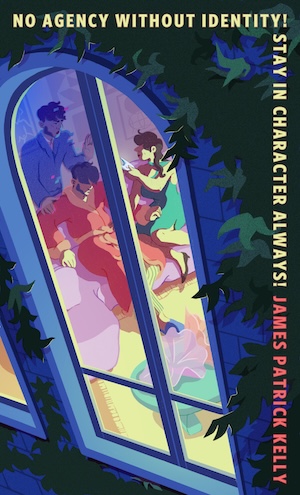
The one totally sane human being lives inside a small building inside a bigger building. The bigger building keeps out the sun, so that we can stand in the dark. The one totally sane human being lives in an apartment that is filled with light.
We stand outside the apartment in the darkness and watch it through the glass. There’s no such thing as one-way glass. There’s only a trick of the light.
The one totally sane human being lives in an apartment that’s about the size of our apartment, and its furnishings mostly look like they were purchased at the kinds of stores where we bought our chairs and cups and so on. The only difference is that its apartment—its enclosure, maybe—has clearly been designed by people who think about the one totally sane human being the way the polar bear people think about the polar bear.
June and I stand in the dark and eventually hold hands while the one totally sane human being makes a sandwich. I can’t tell if the sandwich is peanut butter or tuna salad or something else. Eventually I slip my hand out of June’s and I walk up and stand by the glass. I stand there for a long time.
Once it’s finished making the sandwich, it eats the sandwich. Then it walks around the room. It stands in front of the windows, one and then another, looking out, and then it happens to stand directly in front of me, staring into my eyes. I am whispering It can’t see you it can’t see you it can’t see you because of course it can’t. If the one totally sane human being could see us, it wouldn’t be sane anymore. They’d have to close the zoo.
I’m still whispering when I realize, if it can’t see me, then instead it sees itself. And then instead of hyperventilating I let myself look back into the eyes of the one totally sane human being, the eyes it is using to stare into its own eyes, and I am the leak in the cycle, I am the crack the perpetual motion machine drains into, I am the flaw—
After the one totally sane human being we have our sandwiches, all of mine and the remaining half of June’s. Then we go and see the red pandas and the tapirs and the aardvarks. At the aardvark exhibit June tells me about a children’s book she read where an aardvark has to get glasses. Suddenly I take her hand in both of mine.
When June has finished telling me the story of the aardvark, which she doesn’t stop partway through, no matter how tightly I squeeze, she looks at the real aardvarks for a while.
“I don’t know what it was looking at,” she says.
I think about all the thoughts I have about that and whether they’re one kind of thought or a different kind of thought, and then I put them all down at once, like heavy groceries I had been carrying up a high hill to a house where no one ever eats.
“Me either,” I say. “I never know.”
“Let’s Go to the Zoo” copyright ©2026 by Louis Evans
Art copyright © 2026 by Scott Bakal
Buy the Book

Let’s Go to the Zoo


Well damn…
I too have never seen a boysenberry.
They are real. ;-) They grow in my area.
There’s something deeply haunting about this story that I’m struggling to put a name to. I’m fascinated by it; well done!
This one feels more like psychological horror than anything else. I know a couple that consists of one person who has a terrifying temper that might be set off by anything and also a cognitive issue; and the other person, who is always on watch for anything that might set their partner off and who puts up with mistreatment when that’s easier than coping with yet another meltdown. I don’t think the one totally sane human being exists except in the narrator’s mind. (The caretaker partner also has to play along with the other person’s cognitive glitches, because the other person cannot grasp reality at all, either forgetting or insisting to the point of rage or tears that their delusion is real. Playing along is kinder.)
That’s a super interesting angle for this story!